Podcasting offers a new way of providing audio contents

The official logo of Podcast, designed by Apple Computer in California.
A podcast is an audio file which provides any kind of content. Once you downloaded it, the file can be played on any computer or mobile device. The difference with online radio content is that this is not a streamed file. In other words, you can listen to it when you want and where you want, you don't have to follow a schedule, you can now create your own.

You can find Podcasts from the iTunes Store. When you suscribe to a Podcast, it is automatically downloaded to your iPod.
The term belongs to Apple Computer, the famous brand that invented the iPod. As we learn on this site, on October 16, 2003 the company decided to add Podcasting in their music software : iTunes.
Video sharing explodes with Web 2.0
Even if I don't like the term "Web 2.0" (which I think is just a marketing joke to define the normal evolution of Internet), last news shows us that video sharing is developing very fast nowadays.
First, on online adds, we notice the use of video content instead of static banners.
Then, as we saw on INA's site, the institute is giving us the ability to search for old TV contents. This shows the will to extend historical content not only for texts but also for multimedia.
The last big thing is probably YouTube, the biggest site for video sharing (by the way, they recently launched a special site for adult contents : PornoTube). The site has been bought by Google for or $1.65 billion in stock.
As a matter of fact, the explosion of video files on the Web is yet possible because of bandwidth speed increasing regularly.
Web neutrality is necessary for online trade
As we learn on this page, the Web neutrality is the idea that the companies that own the broadband pipes should not be allowed to reduce competitors broadband speed or to increase their own.
For instance, a company that offers online services and that own the pipes would be tempted to get faster than its competitors.
On the one hand, large broadband players say they have spent a lot of money to build the network, so they have the right to be compensated. But on the other hand, content providers who don't own the pipes, say that this is unfair, that broadband players should get their money back in another way.
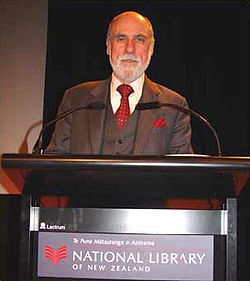
Vinton Cerf
Here, we are talking about Internet's traditional openness. As Vinton Cerf (one of the internet founder) says, there is a risk for start-ups that innovate, if they are limited with their speed, they won't be able to grow. This is a serious issue for innovation.
I believe that Web neutrality is necessary to preserve fair rules. As international trade has to follow WTO, Internet companies sould follow some rules to have the same chance to grow.
Any kind of gate-keeper should be considered as a tax, that the GATT (General Agreement on Taxes and Trade) took years to remove.
Another solution would be to forbid companies that own the pipes to provide contents or services on the Internet. In other words, their role sould be restricted, in order to avoid a skewed market.
As far as I know, Internet was created with a stress on equality, it shouldn't change.
DRM about to reduce Internet freedom

A very famous poster, used by associations against DRM on music files.
DRM stands for Digital Rights Management. This is a piece of code inserted in video, audio or text files which can lock this file in order to protect the author's rights. The code is made of several algorithms, only hackers can get into these codes to remove the DRM. It affects recordings and video because if you did not purchase the file legally, then you won't be allowed to read it. So we face a strange problem : a great amout of protected files are available for download, but you can't do anything with them !
To my mind, the most affected population is most of the time legitimate purchasers, because they are restricted in their use of the content they bought. Let's say you bought a music file on iTunes Store, you won't be able to play it on more than 3 computers. On the other hand, if you don't buy it but download it in MP3 (which doesn't contain any DRM) from à Peer to Peer network, then you would be free to use your file wherever you want. Isn't it unfair ?
Social Networks reveals the end of mass medias
Social networks are websites where you can have your profile and meet new friends. If many people have the same interest, they can easily join a community an be part of a social network.
The main example of a social network is mySpace, this site is very popular in the United States and starts to have the same great succes across Europe.
The potential of these networks is huge for marketing professionals, because each community or group of friends represents a target with its own specificity. You can take part of different networks, depending on your taste, job or occupation. With your profile, advertisers are able to know a lot about your personality. If they cross several files of memebrs, they'll probably be able to make you match with a specific target.
That is already what Google does with their e-mail service : GMail. Robots are reading your messages in order to place contextual ads on your page.
Globally, we can predict that social networks are going to represent the end of mass medias as a model of communication.
posted by Fred at 5:13 PM


0 Comments:
Post a Comment
<< Home